When selecting a CCTV camera, many customers focus only on megapixels or camera resolution. However, a high-resolution camera does not automatically guarantee useful surveillance footage.
This is where the DORI concept becomes important.
What is DORI?
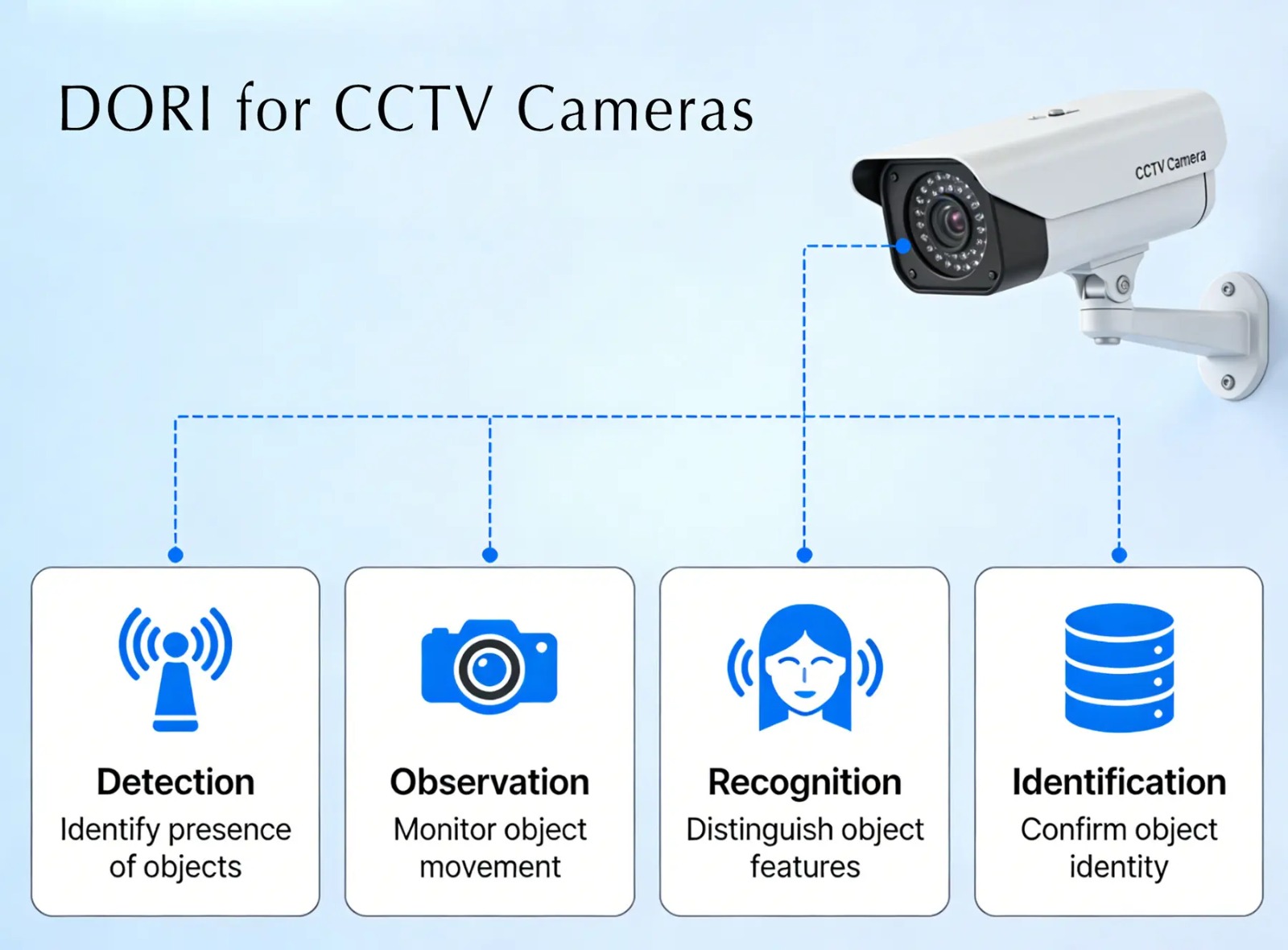
DORI stands for:
- Detection
- Observation
- Recognition
- Identification
It is an international CCTV performance standard defined under:
IEC EN62676-4:2015
The DORI standard helps determine how effectively a camera can distinguish people or objects at different distances.
Instead of simply asking:
“How many megapixels is this camera?”
DORI helps answer:
“What level of detail can this camera actually capture at this distance?”
Why DORI Matters in Real CCTV Deployments
Improper camera selection is one of the most common mistakes in surveillance projects.
For example:
- A camera installed at a building gate may detect movement,
- but fail to identify a face clearly.
This happens when camera placement, lens selection, and pixel density are not properly planned.
DORI helps system integrators design surveillance systems based on actual operational requirements rather than just hardware specifications.
The Four Levels of DORI
1. Detection
The camera can detect that a person or object is present.
Typical use:
- Perimeter monitoring
- Boundary surveillance
- Open parking areas
At this level, you can see movement but may not distinguish details.
2. Observation
The camera allows operators to observe actions or behavior.
Typical use:
- Monitoring crowd activity
- Watching movement patterns
- General situational awareness
You can understand what is happening, but facial details may still be unclear.
3. Recognition
The camera can recognize a familiar person or identify characteristics.
Typical use:
- Office entrances
- Apartment gates
- Reception areas
At this level, operators can distinguish whether a person has been seen before.
4. Identification
The highest DORI level.
The camera captures enough detail to identify a person beyond reasonable doubt.
Typical use:
- Critical entry points
- Cash counters
- Server rooms
- High-security zones
This level is essential for investigations and evidence collection.
Understanding Pixels Per Meter (PPM)
DORI calculations are based on:
Pixels Per Meter (PPM)
PPM measures how many pixels cover one meter of scene width.
Higher PPM means:
- Better image clarity
- Better facial detail
- Better identification capability
Typical DORI guidelines include:
|
DORI Level |
Approx. PPM Requirement |
|
Detection |
25 PPM |
|
Observation |
62 PPM |
|
Recognition |
125 PPM |
|
Identification |
250 PPM |
A camera may provide excellent identification at 5 meters but only detection at 25 meters.
This is why camera placement and lens selection are extremely important.
Why DORI is Important for Bangalore Businesses and Apartments
In Bangalore, surveillance systems are increasingly being deployed across:
- Offices
- Hospitals
- Apartment complexes
- Warehouses
- Retail stores
- IT parks
Many projects fail because cameras are selected only based on price or megapixel ratings.
Proper DORI-based planning helps ensure:
- Better incident investigation
- Improved facial clarity
- Reduced blind spots
- Better compliance
- Smarter camera placement
Final Thoughts
A CCTV camera should not be selected based only on resolution specifications.
The real question is:
“What level of detail do you need at a specific distance?”
That is exactly what the DORI standard helps answer.
At iSecure Solutions, we recommend surveillance design based on operational outcomes, coverage requirements, and DORI-based planning to ensure reliable and future-ready security infrastructure.